Articles & Media
Respect and How it Impacts Patient Safety
When we tolerate a culture of disrespect, we aren’t just being insensitive, or obtuse, or lazy, or enabling. We’re in fact violating the first commandment of medicine: Do No Harm. More
Writing about Medicine
The hustle and bustle of the hospital leaves clinicians very little time for reflection. Writing is a way to slow down time. Writing allows us to revisit events and give them their due. More
Talking about Medical Errors
Doctors and nurses are petrified of making mistakes. They don’t want to kill their patients! But mistakes are inevitable and it’s critical to have a safe place to talk about and address the emotional aspect of medical errors. More
Hidden Curriculum of Medicine
Why do students lose touch with what drove them into medicine by the third year of school? Danielle Ofri talks about the hidden curriculum of medicine and its effect on students’ empathetic skills. More
The Immigrant Healthcare Imperative
Legalizing “undocumented” immigrants might be a boon for our healthcare system. Immigration reform makes both economic and medical sense. A young immigrant from Tibet offers first-hand lessons. More
Patients Need Poetry…And So Do Doctors
Sometimes it is the things we deem least practical that wield the most power. In fact, poetry’s impracticality may be its strength. By being just words on a page, it isn’t expected to pull the weight of chemotherapy, antibiotics, or an MRI machine. So when a poem does pack a punch, we’re often bowled over. More
Developing Empathy
Developing empathy requires good role models during clinical training. Those role models aren’t just your professors and your attendings. Teachers are everywhere in medicine, if you just keep your eyes open and pay attention. More
The Dirty Secret About Medical Errors
As physicians we see medicine as a science. We think of ourselves as rational, evidence-based practitioners. But we are far less rational than we tell our patients and ourselves that we are. More
Can We Let Doctors Be Human?
Is our vision clouded because we are so immersed in the world of sickness? Is it because this helps reinforce the power dynamic that has kept patients “in their place” for centuries? Or might it be because, like our patients we doctors are scared down to our bones? If we were to see our patients living the lives that we live, then there would be nothing to separate them from us. And then we could easily become them. More
An Epidemic of Disillusioned Doctors?
“That’s it,” I thought, after an overwhelming morning in clinic. “I quit!†It’s a thought that crosses the minds of the majority of doctors, it seems. A survey of more than 13,000 doctors found that more than two-thirds feel negatively about their profession. More
Lancet review of “What Doctors Feel”
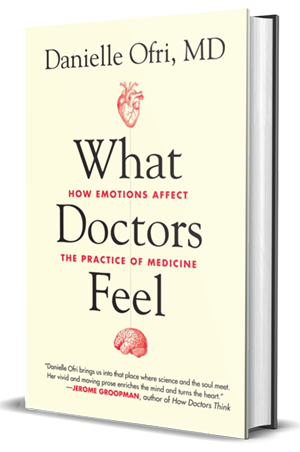
What Doctors Feel: How Emotions Affect the Practice of Medicine is as close to a page-turner as a clinician’s story is likely to become. What Doctors Feel deserves to be well received and widely read. More
NPR Interview with Brian Lehrer: Empathy for “Undesirable” Patients
Doctors have notorious contempt for alcoholics, drug addicts, and morbidly obese patients, and they often make little effort to conceal it. By unspoken rules, these patients are considered fair game for jokes by medical personnel at all levels. Hospital slang for such patients reflects not just disgust but also anger and resentment. More
When Doctors Feel Fear
I remember the first time I laid eyes on an actual amygdala, after slicing through a brain with a repurposed kitchen knife in neuroanatomy class. That’s it? I thought. That nickel-size splotch tucked below the temporal lobes was the seat of my fears? It was monumentally underwhelming and even lacked the poetic almond shape that its Latin name connotes.
More
New York Times review of “What Doctors Freel”
This book’s hallmark is honesty, particularly when it comes to the emotional fallout of her medical mistakes. More
Fear is a Primal Emotion
This was it—the first code I was in charge of. After two years of racing to codes as a first- and second-year resident, now suddenly, the code was mine. I was the one to call the shots, to direct the care, to assign the jobs, to make the decisions….Shit! More