Articles & Media
Lots of New Patients, Too Few Doctors
Getting a primary care doctor is hard these days, and will only get harder as more people get insurance via the ACA. This is a “problem” that we should welcome, since it means that more Americans will have access to care. But it won’t be an easy problem to solve. Here are some ideas that are being discussed. More
Ethical Implications of Incidental Findings
Imagine that you volunteer for memory study and the fMRI also happens to find a life-threatening aneurysm. Your life is saved by the “incidental finding.” But what if tumor that may not be serious is incidentally found? The tumor may not be risky, but the surgery to remove it is. You spend the rest of your life haunted by the decision of whether to operate or whether to wait. What are the ethical implications of incidental findings? A Presidential Commission weighs in. More
Why Doctors Don’t Take Sick Days
From day one in medical training, the unspoken message is that calling in sick is for wimps. Most doctors ignore their symptoms and resist taking the day off unless they are sick enough to be hospitalized in the next bed over. What explains this toxic brew of denial, ignorance and bravado? More
When Doctors Share With Patients
Doctors often “self-disclose” to patients in an attempt to empathize. But contrary to what might be expected, such self-disclosures often turned out not to be helpful in addressing patients’ concerns or building rapport. More
The Challenge of Diabetes
A diagnosis of diabetes often triggers a flurry of life changes and medical interventions. But diabetes–like all chronic illnesses–is a marathon, not a sprint. More
Doctors’ Bad Habits
We doctors constantly lament how difficult it is get our patients to change their behavior. But the truth is, we are equally intransigent when it comes to changing our own behaviors as caregivers. More
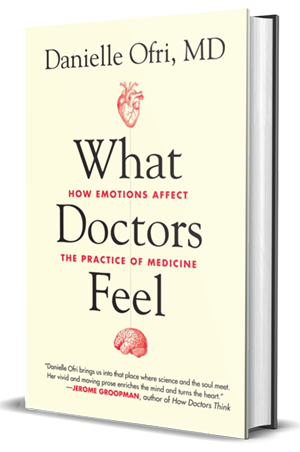
NYU Stories review of “What Doctors Feel”
A rare glimpse into the effects of shuttling from patient to patient without being allowed to process the powerful feelings—fear, anger, grief—that naturally arise when lives are at stake. More
The Raw Fear of Being a Patient
At that moment, my faith in science plummeted from beneath me. My decades of medical training, my Ph.D. in biochemistry, my grounding in the scientific method, all evaporated in the blink of an eye. More
Humanities For Science Majors
For one premed, a chance exposure to an unknown sliver of literature sprung open an entirely new world. The unexpected opportunity to steep in the humanities offered me ways to think and write about medicine that I doubt would have been accessible to me otherwise.
More
More Power to the Placebo
The hospital ward was quiet for the night, except for “the howler.” The patient and I were both pretty exasperated with each other. He was sullen and cranky; I was exhausted and at my wits’ end. More
Doctors Blame Others for Medical Costs
If doctors feel that the grind of medicine is just going to get worse, then they won’t have any stake in making major changes. You can present all the data you want but it doesn’t have a chance when stacked up against emotion and experience. More
Clinical Correlations review of “What Doctors Feel”
As the saxophone virtuoso Charlie Parker said, “If you don’t live it, it won’t come out of your horn.†More
Science-Based Medicine review of “What Doctors Feel”
A patient might reasonably say “I don’t give a damn how my doctor feels as long as she gets me better,†but emotions affect everything we do, influencing clinical decisions and patient outcomes. More
The Doctor Will See Your EMR Now
Like the milkman of yore, the doctor makes rounds every day in the hospital. Alas, this image would be true today only if a computer terminal were plunked in the bed instead of a patient More
BBC Radio
Danielle Ofri is interviewed by BBC News about her book “What Doctors Feel: How Emotions Affect the Practice of Medicine.” (Danielle is a secret BBC groupie, so was especially thrilled to be on this show) More