Solving the Health Care Crisis
Status quo is a powerful determinant of both belief and behavior. This is why incumbents win elections, why we always choose the same flavor of yogurt, why we prescribe the same antihypertensive medications, and why we have our health care system in America. More
Poetry Ward
Toxic sock syndrome. That’s the first thing we noticed when we entered the hospital room. For those gentle readers who are not familiar with such sensory assault, toxic sock syndrome is the clinical term for the rank odor that accompanies damp, fetid feet that have seen more street time than shower time. More
Talking With Doctors
Imagine falling mysteriously ill in a foreign country, in which the language, culture, and customs have no bearing on your own. Imagine trying to find medical help and evaluating your potential healers without understanding the territory, while the shadow of imminent death lingers over your shoulder. This is roughly the experience that David Newman underwent when he discovered that he had a rare tumor that was hovering precariously near his brain stem. The foreign capital was a certain well-known medical city on the Hudson River. More
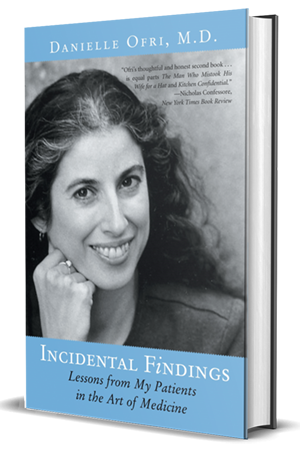
New York Times review of “Incidental Findings”
Ofri’s thoughtful and honest second book…is equal parts “The Man Who Mistook His Wife for a Hat” and “Kitchen Confidential.” The title is inspired by her realization, during her own amniocentesis, that conditions that seem minor to doctors are monumental when they happen to you. More
NEJM review of “Incidental Findings”
Ofri reminds us that medicine is really about the bond between a patient and a physician. “Incidental Findings” is a beautiful book. Ofri has enough faith in her patients, her profession, and herself to tell it all. More
They Sent Me Here
“They told me to give you this,” she said, as she pushed an envelope across the desk toward me. I’ve always been intrigued by who “they” are—those mystery people referred to with such assumed authority and universality. Particularly in a large city hospital, in which the staff is mammoth and constantly changing, “they” constitute a particularly encompassing force. More
Evidence-Based Medicine
Evidence-based medicine often induces more confusion than clarity. It also means different things to different people. More
Residency Regulations—Resisting Our Reflexes
Our instinctive resistance to change reflects not just nostalgia, but the fact that our years of medical training define us in an iconic fashion unique to this profession. Medical training sets social, clinical, and moral barometers by which decades of professional and personal life are gauged. These brief years imprint a personal definition in a manner not seen in other fields: one rarely hears MBAs clucking about crumbling standards and the days of the giants—most view the younger generation with unabashed envy. More
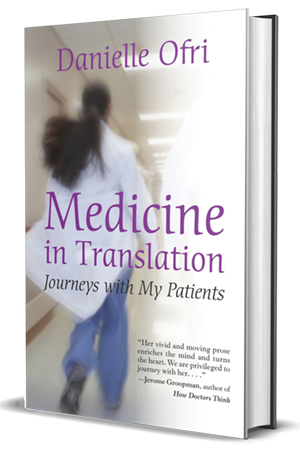
A patient’s heartache, lost in translation
A conversation is a dance between two people, and it involves connection. Speaking through an interpreter, whether it be a human being in the room or a phone handed back and forth, doesn’t allow the same sort of connection. Patients are much less likely to reveal sensitive issues when there is a third-party in the conversation.
Missing the Final Act
Diseases, like dramas, have a natural progression. There are introductions, developments, climaxes, and dénouements. More
Torment
I groan when I catch sight of her name on the patient roster. Nazma Uddin. Not again! She is in my clinic office almost every month. I dread her visits, and today is no exception. More
The Patient vs The Illness
So often in medicine we make it sound like the patient is responsible for the clinical outcomes of their illness. More
Judgement Call
Is the quality of a judgment call determined only by the outcome? Or does it stand alone, with the outcome irrelevant? More
Tools of the Trade
I was ashamed to admit it, but I was perversely thankful for the numerous comatose patients on my service because they made rounds faster and left more time to concentrate on the active GI bleeders, the patients in DKA, the ones with gram-negative septicemia, and the ones who spoke English. More
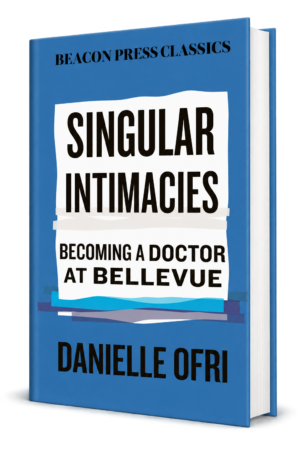
NEJM review of “Singular Intimacies”
Ofri is a gifted writer. Her vignettes ring with truth, and for any physician or patient who knows the dramas of a big-city hospital they will evoke tears, laughter, and memories. Indeed, any reader, physician or not, will find in “Singular Intimacies” the essence of becoming and being a doctor. More