Articles & Media
Residency Regulations—Resisting Our Reflexes
Our instinctive resistance to change reflects not just nostalgia, but the fact that our years of medical training define us in an iconic fashion unique to this profession. Medical training sets social, clinical, and moral barometers by which decades of professional and personal life are gauged. These brief years imprint a personal definition in a manner not seen in other fields: one rarely hears MBAs clucking about crumbling standards and the days of the giants—most view the younger generation with unabashed envy. More
A patient’s heartache, lost in translation
A conversation is a dance between two people, and it involves connection. Speaking through an interpreter, whether it be a human being in the room or a phone handed back and forth, doesn’t allow the same sort of connection. Patients are much less likely to reveal sensitive issues when there is a third-party in the conversation.
JAMA review of “Singular Intimacies”
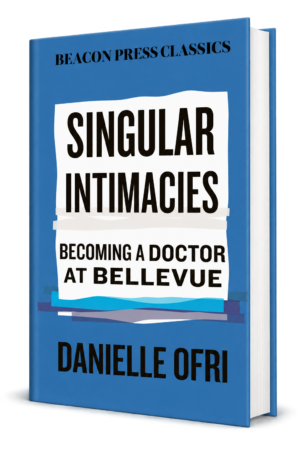
In “Singular Intimacies” Ofri chronicles her training in an adept and touching manner…I found Singular Intimacies extremely engaging. It contains an accurate portrayal of life as a doctor-in-training in a big city hospital. I highly recommend it to anyone who wants an easy-to-read yet thought-provoking book. More
Rationing Patient Care–NPR
Commentator Danielle Ofri is a physician at a big New York City hospital. She tells the story of how a poor patient had little choice but to wait months for a specialist; this would not have been the case if the patient had money. More
Missing the Final Act
Diseases, like dramas, have a natural progression. There are introductions, developments, climaxes, and dénouements. More
Torment
I groan when I catch sight of her name on the patient roster. Nazma Uddin. Not again! She is in my clinic office almost every month. I dread her visits, and today is no exception. More
The Patient vs The Illness
So often in medicine we make it sound like the patient is responsible for the clinical outcomes of their illness. More
Unknown Asian Male–NPR
Commentator Dr. Danielle Ofri tells the story of a patient who was found singing John Denver songs and appeared to be mentally disturbed. But he was simply a victim of poisoning. He’d been given scopalamine, which thieves use to cause amnesia in victims. And luckily, there’s an antidote. More
Judgement Call
Is the quality of a judgment call determined only by the outcome? Or does it stand alone, with the outcome irrelevant? More
Prescribing Good Health–NPR
Commentator Dr. Danielle Ofri tells of one of her patients who was in apparent good health, but who was stuck in low wage job. She knew from statistics that people with such jobs have greater risk of dying early. So she tutored him in his SATs so he could get into college. More
Tools of the Trade
I was ashamed to admit it, but I was perversely thankful for the numerous comatose patients on my service because they made rounds faster and left more time to concentrate on the active GI bleeders, the patients in DKA, the ones with gram-negative septicemia, and the ones who spoke English. More
NEJM review of “Singular Intimacies”
Ofri is a gifted writer. Her vignettes ring with truth, and for any physician or patient who knows the dramas of a big-city hospital they will evoke tears, laughter, and memories. Indeed, any reader, physician or not, will find in “Singular Intimacies” the essence of becoming and being a doctor. More
Boston Globe review of “Singular Intimacies”
With health insurance and malpractice costs rising, and with patient satisfaction becoming an oxymoron, along comes the compassionate Danielle Ofri with ”Singular Intimacies.” Her writing tumbles forth with color and emotion. She demonstrates an ear for dialogue, humility about the limits of her medical training, and an extraordinary capacity to be touched by human suffering. More
Boston Globe Book Review: “Singular Intimacies”
Danielle Ofri’s ”Singular Intimacies: Becoming a Doctor at Bellevue” captivated me so much. Ofri is fascinating not just because she’s an attending physician at Bellevue, ”the oldest and craziest hospital in the nation,” but because she’s also the cofounder and editor in chief of the revolutionary Bellevue Literary Review. More
Washington Post review of “Singular Intimacies”
Ofri discovered that she could draw a line between being a doctor and being a woman, that she could hate one patient and care deeply about another, that she could battle the medical establishment and even herself, and that despite modern medicine and her belief in the power of intellect, death conquers all. More