Articles & Media
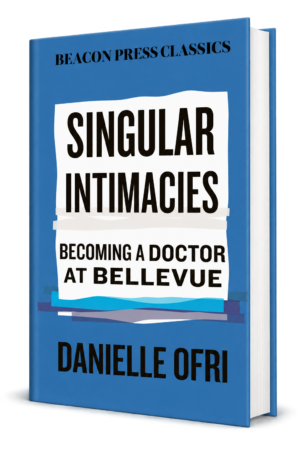
July 1st–excerpt from “Singular Intimacies”
“It suddenly dawned on me that I’d never had a lecture in medical school on how to tell if someone is dead.” More
Part-Time Medicine
At times, being a part-time doctor feels like I’m somehow shirking the Hippocratic Oath: I’m not there for my patients all the time like a doctor should. During my “on” days, I work furiously like all of my colleagues. But on my “off” days, I am officially off. More
Resistance–Review of Abba Kovner’s poetry
Abba Kovner–leader of the Vilna ghetto uprising–was also a remarkable poet. His book of poems entitled “Sloan Kettering” is well worth the read for its lessons in history, mortality, medicine, and beauty. More
Medicine: An Uncertain Art
As surely as the first bill for malpractice insurance lands on the desk, so too does the awkward lesson of clinical medicine—that the scientific certainty dished out by the medical establishment represents only a small portion of what clinical practice actually is. More
New Pages review of the Bellevue Literary Review
The Bellevue Literary Review describes itself as “A journal of humanity and human experience.” Reading the Spring 2008 volume, I continually concluded that BLR could not be described more appropriately. More
Solving the Health Care Crisis
Status quo is a powerful determinant of both belief and behavior. This is why incumbents win elections, why we always choose the same flavor of yogurt, why we prescribe the same antihypertensive medications, and why we have our health care system in America. More
Poetry Ward
Toxic sock syndrome. That’s the first thing we noticed when we entered the hospital room. For those gentle readers who are not familiar with such sensory assault, toxic sock syndrome is the clinical term for the rank odor that accompanies damp, fetid feet that have seen more street time than shower time. More
Talking With Doctors
Imagine falling mysteriously ill in a foreign country, in which the language, culture, and customs have no bearing on your own. Imagine trying to find medical help and evaluating your potential healers without understanding the territory, while the shadow of imminent death lingers over your shoulder. This is roughly the experience that David Newman underwent when he discovered that he had a rare tumor that was hovering precariously near his brain stem. The foreign capital was a certain well-known medical city on the Hudson River. More
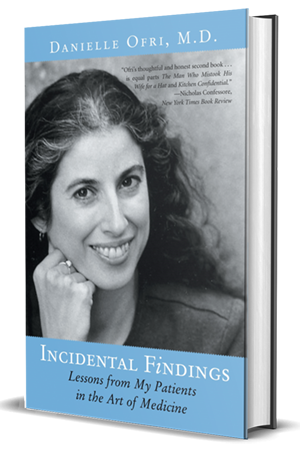
New York Times review of “Incidental Findings”
Ofri’s thoughtful and honest second book…is equal parts “The Man Who Mistook His Wife for a Hat” and “Kitchen Confidential.” The title is inspired by her realization, during her own amniocentesis, that conditions that seem minor to doctors are monumental when they happen to you. More
Prairie Schooner review of “Incidental Findings”
Danielle Ofri is a shaman. She might balk at the title as a medical doctor, yet her essays grapple with moments when traditional medicine has failed her, when science seems no more than empty ritual, and she feels as blind as her patients to the mysteries of health and illness. In such moments, Ofri instinctively turns to her patients’ emotional anatomy: the tumors of despair, the hot blood of hope, the pulsing will to live. More
Bookworm Sez review of “Incidental Findings”
When I got this book, I couldn’t wait to read it. I loved Ofri’s first book, so I knew what awaited me and I wasn’t disappointed. Danielle Ofri writes with grace and gentle humor. She uses real medical terms, but she makes them easy to understand. She’s thoughtful and compassionate; the kind of physician everyone hopes to have. She’s willing to admit when she was wrong (or not quite right), which is something not a lot of doctors are brave enough to admit in public. More
NEJM review of “Incidental Findings”
Ofri reminds us that medicine is really about the bond between a patient and a physician. “Incidental Findings” is a beautiful book. Ofri has enough faith in her patients, her profession, and herself to tell it all. More
JAMA review of “Incidental Findings”
In several stories Ofri recounts her own experiences as a patient. She is surprised at how different things are on the other end of the doctor-patient relationship. Ofri discovers firsthand how poorly doctors prepare their patients for procedures and explain findings that may be ordinary in medicine but are frightening to patients.The writing is engaging, and I highly recommend Incidental Findings to anyone who wants to read a short, well-written, and thought-provoking book. More
They Sent Me Here
“They told me to give you this,” she said, as she pushed an envelope across the desk toward me. I’ve always been intrigued by who “they” are—those mystery people referred to with such assumed authority and universality. Particularly in a large city hospital, in which the staff is mammoth and constantly changing, “they” constitute a particularly encompassing force. More
Evidence-Based Medicine
Evidence-based medicine often induces more confusion than clarity. It also means different things to different people. More