Danielle Ofri
Doctors need to be aware of their own biases towards patients
Modifying our external behavior and how we communicate is clearly important, but I believe we in the medical profession have a duty to work to change our inner landscapes as well. It’s a tall order, I realize, but if we wish to claim the high mantle of professionalism, we need to at least be actively attempting to challenge our gut feelings. More
Globe & Mail review of “What Patients Say, What Doctors Hear”
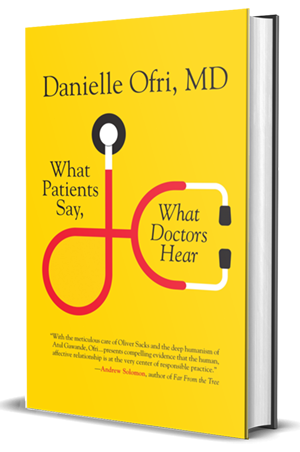
Ofri argues in her new book “What Patients Say, What Doctors Hear” that the conversations doctors have with their patients are the most important part of a medical visit, far surpassing blood tests, X-rays or various scans. And she believes it’s time both doctors and patients give these conversations their due. More
Washington Post Review of “What Patients Say, What Doctors Hear.”
“If you’ve switched physicians in search of someone more caring, or left an exam feeling unseen and unheard, you will find much to appreciate in Danielle Ofri’s perceptive book.” More
A Bellevue Doctor on Trump, Exam Room Conversations and Her New Book
Ofri draws on anecdotes and evidence in her new book, “What Patients Say, What Doctors Hear,” to argue that, even as technology advances, conversation between patients and doctors remains the “most potent diagnostic—and therapeutic—tool in medicine.” More
Are We Missing the Most Important Aspect of Health Care?
As the medical industry strives for a virtual world in which diagnoses are made and prescriptions rendered on a smartphone app, Ofri argues that successful conversation is the primary driver of healing. Sadly dialectics remain a longstanding elephant in the office: doctors enter with opinions, patients their own, the ticking clock on the wall in plain view of both parties. More
Moth Radio Hour
“July First” is the story of my first week of internship at Bellevue Hospital. It was the middle of the night, on the 16-West ward, when I faced the first existential crisis as a doctor. More
The Conversation Placebo
Pain remedies developed by the pharmaceutical industry are only modestly effective, and they have side effects that range from nausea and constipation to addiction and death. What’s often overlooked is that the simple conversation between doctor and patient can be as potent an analgesic as many treatments we prescribe. More
Should Doctors Treat Trump Anxiety?
Doctors deal with side effects all the time—side effects of medications, side effects of diseases, side effects of treatments. But side effects of an election is new territory for us. We can report medication side effects to the FDA, but to whom do we report election side effects? More
Podcast: Listen to the Patient!
Danielle is interviewed by Joe Elia from the New England Journal of Medicine about her new book, “What Patients Say, What Doctors Hear.” More
Danielle Ofri’s TED Talk on “Fear: A Necessary Emotion”
Fear is a perfectly human state for a doctor to be in. However, it’s not necessarily the most ideal situation for your patient to be in. Danielle Ofri’s TED talk is a harrowing journey through the intricacies of fear. More
Poetry in Medicine
When I make rounds with medical students and interns, I’ve often tried to sneak in a poem at the end. It’s not always the most well-received bit of medical teaching, More
“The Waiting Room”
The novel, “The Waiting Room,” takes place over the course of a single day, and captures how a doctor and her community of patients navigate the crises of both their inner worlds and the outer world. More
“Healing Words” interview
Danielle Ofri interviewed at the Mayo Clinic about writing, healing, and medicine. More
Booklist review of “What Patients Say, What Doctors Hear”
It may sound old-fashioned, but when it comes to encounters between doctors and patients, talk (the medical interview) and touch (the physical exam) trump technology. More
Free Public Lecture in Boston Dec 1
Join Danielle for a free public lecture in Boston about emotions in medicine. More