Danielle Ofri
The Most Powerful Tool in Medicine
Danielle Ofri speaks at the Mayo Clinic about conversation as the single most powerful tool in medicine. More
Viva Italiano!
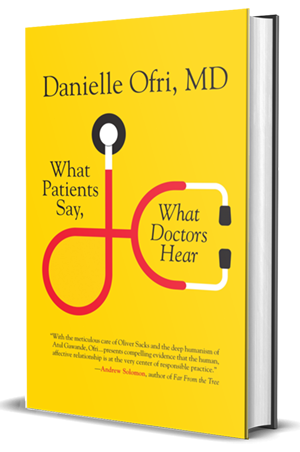
Ciao! We are thrilled that “What Patients Say, What Doctors Hear” is now available in Italian. Grab an espresso and your copy of “Cosa dice el malato, cosa sente il medico.” More
Danielle Ofri’s TED Talk on “Deconstructing Perfection”
Shame, guilt, fear—you can’t tally these on a spreadsheet, but they are the biggest elephants in the room when it comes to medical error. Danielle Ofri makes a powerful, against-the-grain case about perfection that could lead to dramatic improvements in care and ultimately could save lives. More
Medical Humanities: The Rx for Uncertainty?
A large part of our medical maturation is facing uncertainty and then accepting it into our fold. This is far harder than memorizing all those rare diseases. The humanities can offer doctors a paradigm for living with ambiguity and even for relishing it. More
One Last Visit to See My Patient
My 91-year-old patient and I had been together for some 20 years—honestly I’d lost count—so visiting her at home, even in the torrential rain, was the least I could do. More
Nothing Glamorous about Opioid Addiction
Pain stands nearly alone as a medical condition that not only can’t be measured but that patients might also have an ulterior motive to lie about. I never wonder if a patient is lying when she says she is constipated or has a vaginal itch. But the reality is that there’s not much street value for Metamucil, and there aren’t any rehabs filled with recovering Monistat addicts. More
How We Treat Our Fellow Americans
The blossoming truth of “No Apparent Distress” is that a segment of American society has been casually cast aside, left to scavenge on the meager scraps of volunteer health services, and failing that, left to die. Some politicians might call this “choice.” A more medically accurate term would be abandonment. More
AJN Review of “What Patients Say, What Doctors Feel”
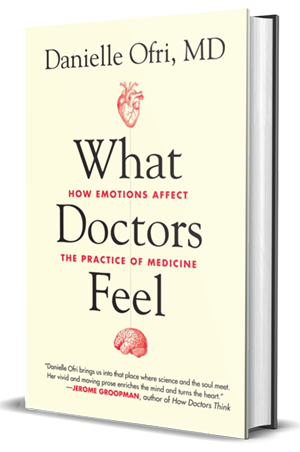
Can any of us, nurses or physicians, say that we always listen as well as we should, giving each patient’s story our full attention? Like physicians, nurses feel the unrelenting pressure of time constraints. Ironically, such listening can save time in the long run. More
ReachMD Book Club
Danielle is interviewed by Maurice Pickard for the ReachMD Book Club.  Listen to the conversation about how the quality of the doctor-patient conversation can have a direct effect on medical outcomes. More
“Review of Systems” Podcast
Danielle is interviewed by Audrey Provenzano for the podcast “Review of Systems.” Listen to the conversation that covers communication, doctor-patient relationship, medical activism, and what happens when patients gain more power in the conversation that physicians. More
Healthcare’s Biggest Conflict of Interest
The doctor-patient relationship is a one-on-one interaction, and so conflicts of interest are concrete and directly personal. Medical decisions can be swayed by money, even unconsciously, regardless of whether it’s from insurance companies or from industry. But the most basic conflict of interest is that health care access is tied to health insurance. Presence or absence or extent of health insurance is the most powerful influence on how doctors care for patients. More
BMJ review of “What Patients Say, What Doctors Feel”
It is the oldest tool in any doctor’s bag, and it is as important today as it was 200 years ago. It is not a device, gadget or pill. The side-effects are minimal, and it’s amongst the cheapest remedies around. It is, of course, the art of conversation More
Intima review of “What Patients Say, What Doctors Hear”
In a time when technology seems to outpace humanity, many in the medical profession are trying to bridge the communication gap. One indicator is the growing recognition of the importance of stories – personal narratives of patients and doctors – as a key component of successful medical practice. More
A Singular Intimacy
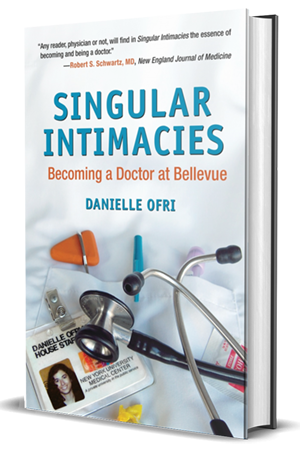
Despite enormous advances in healthcare, patients and caregivers alike are dissatisfied with their experience. So much of medicine has been boiled down to rote algorithms and assembly-line care. Seeking inspiration from the gripping narratives of urban medicine to the unlikely poetry of the ICU, Danielle Ofri probes the most fundamental aspect of medical care—how caregivers and patients connect. More
POTUS 2017 TV Interview
Is there a difference between calling an insurance company about a prior authorization and calling a Senator about legislation? Danielle talks about why doctors and nurses need to stand up politically for their patients. More